Libertarians are those weird little guys who lurk in their parents’ basement—spouting out conspiracy theories, smoking funny things, and reading books many have never even heard of, right?
Well...some libertarians are those odd little guys and gals. But even more libertarians are average men and women, grandpas and grandmas, artists, business professionals, blue-collar workers, teachers, students, and people from all walks of life. Libertarians are everywhere you look. Some openly identify as such; others need to be alerted to the fact.
I am convinced that the average person on the street is open to libertarian principles. And many of them are libertarian to one degree or another. Perhaps it would take some explanation and flushing out of the issues for folks to identify as libertarian, but liberty is a popular idea. Most people want liberty and the government out of their business, however many do not realize that this is libertarianism. (Continue reading here.)

Showing posts with label Beltway Libertarianism. Show all posts
Showing posts with label Beltway Libertarianism. Show all posts
Monday, April 19, 2010
What Is A Libertarian?
Checkout my latest at The Humble Libertarian.


Saturday, March 20, 2010
Term Limits or Electoral Accountability?
Please check out my latest column at The Humble Libertarian on term limits.
It begins:
It begins:
Whether at Tea Party events or in general political discourse, I often hear a great desire for term limits voiced by people frustrated with our out-of-control government. They hope that the implementation of congressional term limits would go a long way toward solving our political ills. I, however, am not convinced. In fact, I believe that we already have a system of term limits in place; we just don't use it. It's called elections.
Every politician has his day in court each election cycle. Sadly, we often neglect carrying out the sentence most politicians deserve- a trip back home. Instead, time after time, we reward those who trample our liberties and ally themselves with powerful special interests by sending them back into office to continue their misdeeds.
Indeed, the electorate is very much a part of the problem. Failing to punish unconstitutional action, we have encouraged a system of legal looting and constitutional neglect. Term limits might allow individual politicians less time to carry out their abuse, but they will not solve the problem. (Continue here.)
Friday, February 26, 2010
Beltway Libertarianism vs. the Revolution: Part 2
Before I continue on with the topic of beltway libertarians vs. the Austrian libertarians, I wold like to clarify something that came up in the comments section for yesterday's post. The divide between the two strands is not merely one of demographics or some other superficial factor, it is a philosophic division.
I would also once again clarify that though I identify more with the Austrian brand of libertarians, I greatly appreciate mainstream libertarians and use their resources as well as communicate with them often. Our slight philosophical differences is not enough to put a significant wedge between us. What I do not enjoy is unfounded criticisms and ad hominem attacks from either side. That is what brought this post about. I have seen the attacks go on for years, but the article The Ron Paul Delusion from Reason finally broke the camel's back--so to speak.
In the article, David Harsanyi goes out of his way to smear Ron Paul, who has single-handedly grew the libertarian movement in recent years by leaps and bounds.
His article begins by offering a legitimate point, which is that his CPAC straw poll victory does not mean that Ron Paul is the new leader of the Republican Party. But Harsanyi quickly turns from his subject to take a jab at the Texas congressman. After offering a rhetorical question as to whether the GOP will become the party of Paul, Harsanyi goes into the following:
Harsanyi then attacks Paul's credentials as as serious thinker--another unfounded claim with evidence to the contrary. Paul is an author of many works that go well beyond the level of reading many are willing to take on outside the walls of academia. Moreover, his positions are held deeply based on cohesive philosophical reasoning. That alone requires serious thought from a serious man. Moreover, the same should be said of his economic and historical scholarship. There is no reason for Harsanyi's statement. Apparently, most of us define "serious thinker" quite differently than Mr. Harsanyi.
After this tirade against Paul, Harsanyi get back on his topic, but not for long. I quote:
Isolationism? You must be talking about someone else. Ron Paul is far from an isolationist; he is a non-interventionist. Like Thomas Jefferson, Paul believes in "peace, commerce and honest friendship with all nations; entangling alliances with none." What he does not endorse is the reckless wielding of military might, imperialism, and unnecessary killing. If you hold a position counter to this, I am sorry that Paul won't play along with you war games.
I am not sure what is meant by "half-baked crusades," but I am sure based on each man's track record, I would land on the side of Paul.
Harsanyi then goes beyond attacking Paul to attacking Paul's supporters: "Perhaps the greatest tragedy of Paul is that thousands of intellectually curious young people will have read his silly books, including End the Fed, as serious manifestoes." I am sorry if we take him seriously because he speaks to issues that greatly affect us. We cannot help but take him seriously. He has seriously fought for liberty throughout his career. Mr. Harsanyi on the other hand seems content simply promoting liberty-lite. (Just read any of Harsanyi's previous work for examples.)
I believe Harsanyi is wrong to say, "Ron Paul as the leader of [the conservative movement]—or, actually, any—charge is a mistake for both parties." but I am also think that he is wrong to denounce Paul while praising Cato's David Boaz as a serious libertarian. I don't say this to downplay Boaz; has done good work for liberty. My point is merely that Harsanyi is picking a fight that need not be fought. You can have both your Paul and your Boaz and do just fine. I will do so myself, but I can't take much more of David Harsanyi or those like him.
There is a divide in libertarianism; it can be overcome. But name calling and unfounded position bashing will not do it.
I would also once again clarify that though I identify more with the Austrian brand of libertarians, I greatly appreciate mainstream libertarians and use their resources as well as communicate with them often. Our slight philosophical differences is not enough to put a significant wedge between us. What I do not enjoy is unfounded criticisms and ad hominem attacks from either side. That is what brought this post about. I have seen the attacks go on for years, but the article The Ron Paul Delusion from Reason finally broke the camel's back--so to speak.
In the article, David Harsanyi goes out of his way to smear Ron Paul, who has single-handedly grew the libertarian movement in recent years by leaps and bounds.
His article begins by offering a legitimate point, which is that his CPAC straw poll victory does not mean that Ron Paul is the new leader of the Republican Party. But Harsanyi quickly turns from his subject to take a jab at the Texas congressman. After offering a rhetorical question as to whether the GOP will become the party of Paul, Harsanyi goes into the following:
Let's, for a moment, forget Paul (and how I wish this could be a permanent condition, considering the congressman is neither a serious politician nor—and I can't stress this enough—a serious thinker).This is completely uncalled for and completely unfounded. Ron Paul is a serious politician. His not winning the presidency doesn't negate his multiple congressional race successes. If we are to measure "serious politicians" by those who have achieved the office of president, only 43 men in our history have been serious politicians.
Harsanyi then attacks Paul's credentials as as serious thinker--another unfounded claim with evidence to the contrary. Paul is an author of many works that go well beyond the level of reading many are willing to take on outside the walls of academia. Moreover, his positions are held deeply based on cohesive philosophical reasoning. That alone requires serious thought from a serious man. Moreover, the same should be said of his economic and historical scholarship. There is no reason for Harsanyi's statement. Apparently, most of us define "serious thinker" quite differently than Mr. Harsanyi.
After this tirade against Paul, Harsanyi get back on his topic, but not for long. I quote:
"Congressman Paul is committed to bringing the conservative movement back to its traditional platform of limited government, balanced budgets and a foreign policy of nonintervention," claims Jesse Benton, Paul's spokesman.
If only it stopped there. Paul isn't a traditional conservative. His obsession with long-decided monetary policy and isolationism are not his only half-baked crusades. Paul's newsletters of the '80s and '90s were filled with anti-Semitic and racist rants, proving his slumming in the ugliest corners of conspiracyland today is no mistake.
Perhaps the greatest tragedy of Paul is that thousands of intellectually curious young people will have read his silly books, including End the Fed, as serious manifestoes. Though you wouldn't know it by listening to Paul or reading his words, libertarians do have genuine ideas that conservatives might embrace.Long-decided monetary policy? I am sorry, sir. But this establishment position on monetary policy may be popular, but things are far from decided. We have seen massive explosion of government spending and financial instability directly because of the rise of fiat currency. The monetary policy of Paul has been right all along and we are seeing the Austrian predictions unfold daily before our very eyes.
Isolationism? You must be talking about someone else. Ron Paul is far from an isolationist; he is a non-interventionist. Like Thomas Jefferson, Paul believes in "peace, commerce and honest friendship with all nations; entangling alliances with none." What he does not endorse is the reckless wielding of military might, imperialism, and unnecessary killing. If you hold a position counter to this, I am sorry that Paul won't play along with you war games.
I am not sure what is meant by "half-baked crusades," but I am sure based on each man's track record, I would land on the side of Paul.
Harsanyi then goes beyond attacking Paul to attacking Paul's supporters: "Perhaps the greatest tragedy of Paul is that thousands of intellectually curious young people will have read his silly books, including End the Fed, as serious manifestoes." I am sorry if we take him seriously because he speaks to issues that greatly affect us. We cannot help but take him seriously. He has seriously fought for liberty throughout his career. Mr. Harsanyi on the other hand seems content simply promoting liberty-lite. (Just read any of Harsanyi's previous work for examples.)
I believe Harsanyi is wrong to say, "Ron Paul as the leader of [the conservative movement]—or, actually, any—charge is a mistake for both parties." but I am also think that he is wrong to denounce Paul while praising Cato's David Boaz as a serious libertarian. I don't say this to downplay Boaz; has done good work for liberty. My point is merely that Harsanyi is picking a fight that need not be fought. You can have both your Paul and your Boaz and do just fine. I will do so myself, but I can't take much more of David Harsanyi or those like him.
There is a divide in libertarianism; it can be overcome. But name calling and unfounded position bashing will not do it.
Thursday, February 25, 2010
Beltway Libertarianism vs, the Revolution: Part 1
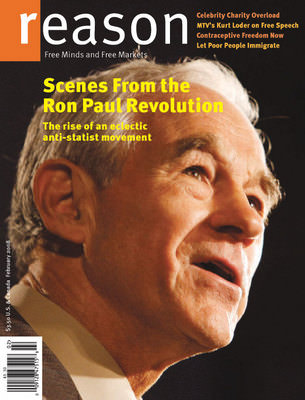
I am at times identified as a conservative by some and a libertarian by others. Personally, I don't mind either label taken within context, and I frequently self-identify as both. However, when talking to someone who understands the massive web of ideological labels about my libertarianism, I often admit to being a paleolibertarian. Moreover, I don't only self-identify; I've tested this way in a number of ideological tests set to determine political ideology. So I guess I really am.
So what does all this mean? Why is it important? Well...to be honest, it is not always important. Whether I call myself a conservative, a libertarian, a paleoconservative, or a paleolibertarian, after talking with me about political policy and theory, it soon becomes quite clear that I merely believe in the unalienable rights of the individual and the strict restraining of the state. Therefore, what I am called will in no way affect my beliefs, my stances, or your agreement with my positions. But that does not mean there are not times that when it is very important to properly show where we hang our philosophical hat. (I hang my beside Jefferson on the rack of classical liberalism, by the way.)
The reason for different ideological identifiers is simply to offer distinction among differing positions. Some think that by not calling themselves conservative, and instead identifying as libertarian, they have solved their identity problem. Sadly, I am here to tell you that such is not the case. Not all libertarians are created equal...heck, some aren't even really libertarians.
There are a number of different movements and segments that fall underneath the libertarian banner, but there are two main groups that represent the libertarian movement of today--beltway libertarians also known as mainstream libertarians and what are called laissez faire libertarians, paleolibertarians, or Austrian libertarians. The former group is made up of those from places like the Cato Institute, the Reason Foundation, and some in the Libertarian Party. The latter is made up of Mises Institute scholars and associates as well as other economic Austrians. The former represents more mainstream libertarianism and the actors that go along with that like Koch and Friedman. The latter is represented by those like Ron Paul, Lew Rockwell, Murray Rothbard, F.A. Hayek, and Ludwig von Mises.
Needless to say, Beltway libertarianism is feeling a little left out by the current rEVOLution going on among many, spurred on by Ron Paul's 2008 presidential bid. However, this is no new divide. Long before Congressman Paul came to national prominance, he was known in libertarian circles. Some liked him, but some of our beltway brothers were less than enthusiastic about the good doctor from Texas. The reason: many of them are not interested in philosophical purity. While many of them might at one time might have held positions of the Old Right, they have long since abandoned them. Many are now pro-war, pro-partisanship, and (dare I say) pro-state. Corrupted by the plagues of Washington, they now despise anyone who hasn't been themselves corrupted.Therefore, they never miss an opportunity to trash Paul and others who still remain committed to anti-statist policies.
Just look at the Cato Institute's Brink Lindsey's comments:
“Though Paul defines himself as a libertarian and attributes the dedication of his young supporters to libertarian positions — such as allowing people to opt out of Social Security and Medicare — many libertarian pundits say Paul isn’t in sync with younger, more ‘modern’ libertarians...He’s sort of an old-style, old-right libertarian candidate. Paul departs from younger libertarians with his opposition to abortion rights and free trade agreements, for example.”
I would have to disagree with Mr. Lindsey based on the vast display of evidence. Young people are the very lifeblood of Paul's movement. Moreover, Linsey's pro-war position has done nothing to rouse youth support for himself or his organization.
Lindsey is not alone in his dislike for Ron Paul and libertarians of his kind (Though the above quotation seems harmless, I assure you Lindsey is no fan of a number of Paul's policies.) Reason magazine editor, Nick Gillespie notes the following:
“[Paul] has a set of principles applied consistently. He’s not a bulls**t artist...I think that’s very attractive to younger voters who are too stupid to realize that’s not how politics works.”
There you have beltway libertarianism in a nutshell--proud of compromise and condescending to those that are not. Well...Mr Gillespie, Ron Paul supporters are far from stupid, and politics isn't working; that is the problem. These guys have snuggled up to the state and are awfully upset that others have not.
I rather enjoyed Justin Raimondo's commentary on Gillespie's words:
"Yeah, those poor dumb jerks, who actually believe that principles matter, and individuals can act to make history: they’ll soon learn! This is the typical mantra of the Beltway know-it-alls, who have no real connection to the actually-existing libertarian movement—Gillespie came out of a short-lived online magazine entitled “Suck”—and wouldn’t lower themselves, either. That doesn’t stop these generals without an army from pontificating, judging, and often belittling the movement, and especially cultural conservatives like Ron Paul, who don’t fit into their own narrow little cultural paradigm."
So, as you can see from the above examples, there is a quite a divide between beltway libertarians and movement purists like the Paulites. This does not mean that the divide cannot and is not often overcame. Moreover, just because someone is affiliated with Cato or Reason that doesn't mean that they are beltway in their thinking and actions. Even if they are, that doesn't mean they are not good folks with good ideas. Many fine people are involved with both organizations, and I am a fan of each. I profit from their resources and value their contributions to liberty. However, I often have to keep a closer eye on them as I know what some in the beltway movement pursue and support.
This post came about as I read this article Wednesday. I thought some might question why a Reason article would be so harsh on Ron Paul, and I wanted to provide an answer. Tomorrow, I will provide a response to the article and more on the beltway libertarians. But for now I have taken enough of your time. Just remember that not all libertarians view things the same way, not even broadly. You can support both (and I encourage you to do so,though I obviously identify with the Paul movement more myself), but know that each side is not necessarily supporting each other all of the time.
To be continued...
PS: If you have any questions or concerns on the matter, I cannot promise to have all the answers, but I'll address them the best I can. Just leave questions or comments in the comments.
Subscribe to:
Posts (Atom)