Showing posts with label Supreme Court. Show all posts

Sunday, May 16, 2010

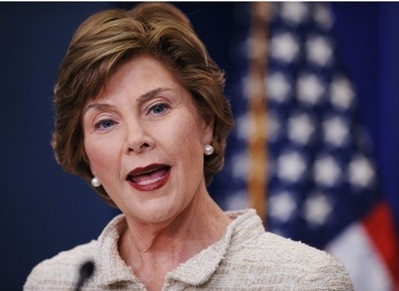
Laura Bush's Support of Elena Kagan

Former First Lady Laura Bush voiced her support for President Obama's new Supreme Court nominee, Elena Kagan, on Sunday noting:
"I think it's great. I'm really glad that there will be three [women] if she's confirmed. I like to have women on the Supreme Court."

Bush added: "I think it does make a difference. And you know, I just like women to be represented in all parts of American political and civic life."
Mrs. Bush's statements are ridiculous on two major fronts. One one hand, to support someone based on gender rather than principle is plain foolish. On the other hand, it is a massive double standard that would not be toloerated if the tables where turned.

There is nothing wrong with Mrs. Bush supporting Kagan for the right reasons. Being the wife of a Republican president does not prohibit her from liking Obama's nominee, but being thrilled merely because of the nominee's gender is just plain stupid. Decisions like this should be supported based on factors like judicial philosophy, not mere physical characteristics.


I could care less if the Court was made up of 2 women, 3 women, or 9 women. In fact, I'd rather have 9 constitutionalist women over any assortment of men or women who do not respect the rule of law. Sadly, Laura Bush's preference finds shallower support.


What is really shocking about the former First Lady's statement is the double standard it presents. Imagine if a man said he was thrilled with a male nominee because of gender; the fallout would be huge. Of course, people are free to their opinions, but we should hold each to a uniform standard.


If Mrs. Bush likes Kagan, she should do so based on judicial merit. Sadly, that is not the case. Hopefully, the Senate will show support or opposition for reasons that transcend gender.


(Watch the video here.)

Monday, May 10, 2010

Opponents Should Be Careful About New SC Nominee Kagan's Lack of Judicial Experience

With famed liberal Justice John Paul Stevens stepping down from the Supreme Court, the Obama administration has been looking far and wide to find what it deems a suitable replacement. For now, the search seems to be over.

The Associated Press reports:
WASHINGTON – Solicitor General Elena Kagan will be nominated Monday to the Supreme Court by President Barack Obama, pushing the former law school dean toward the pinnacle of her profession and positioning the United States to have three women justices for the first time in its history.

Obama will announce his choice at 10 a.m. in the East Room of the White House alongside Vice President Joe Biden. Kagan will also speak. The room will be filled with Kagan's Justice Department colleagues and other guests invited to soak in one of a presidency's biggest moments.
Unknown to most, Kagan is already being closely investigated before her Senate hearing even begins. One major item that is already receiving much attention is Kagan's lack of judicial experience, having never served as judge. Opponents of the nominee would be wise to not make this a major point of contention.

There is no constitutional requirement that a Supreme Court justice have previous experience as a judge prior to joining the Court, and a number of justices throughout our history have lacked said judicial experice. Even in the modern age we have seen similar circumstances.

William Rehnquist, who served as our last chief justice, lacked experience as judge before joining the Court, but he was obviously able to excel at the position. Agree with him or not, he performed the technical aspects of the job quite well and was well respected.

Knowing these things, those who find contention with Kagan as a choice should look to her views of the Constitution, judicial authority, and the like when making their decision, rather than hamper on her lack of judicial experience. If they fail to do so, they show their own ignorance of history and unwillingness to do the heavy lifting in vetting the candidate.

Tuesday, April 20, 2010

A Victory for Free Expression...Court Upholds Unpopular Expression

The Washington Post  reports on the latest victory for free expression:
The Supreme Court struck down a federal law Tuesday aimed at banning videos depicting graphic violence against animals, saying that it violates the constitutional right to free speech.

Chief Justice John J. Roberts Jr., writing for an eight-member majority, said the law was overly broad and not allowed by the First Amendment. He rejected the government's argument that whether certain categories of speech deserve constitutional protection depends on balancing the value of the speech against its societal costs. 
"The First Amendment's guarantee of free speech does not extend only to categories of speech that survive an ad hoc balancing of relative social costs and benefits," Roberts wrote. "The First Amendment itself reflects a judgment by the American people that the benefits of its restrictions on the Government outweigh the costs. Our Constitution forecloses any attempt to revise that judgment simply on the basis that some speech is not worth it." 
The law was passed in 1999 in an attempt to prevent the sale of "crush films"--fetish films in which animals are crushed. The law, however, is so overly broad that it could be used against hunting videos and mere depictions of violence toward animals.

Writing for the Court, the Chief Jusice noted that as written the law “creates a criminal prohibition of alarming breadth.”  The SCOTUS blog reported, "Noting that the government had given assurances that it would enforce the law only against commercial portrayals of “extreme cruelty,” the Chief Justice wrote that the Court would not uphold an unconstitutional law “merely because the government promises to use it responsibly.”"

The Cheif Justice is right to call into question reliance on responsible usage of the law. Any chance for abuse must be nipped in the bud when its knowledge arises. 

It should be noted that the Court's ruling was not against the ability of the federal government to legislate against animal cruelty. Rather, the ability to ban videos depicting such was called into question. The Court thankfully took the right stand refusing to further gut First Amendment protection.

It has long been noted that the First Amendment is not needed to protect popular expression. Rather, it is the unpopular which warrants protection. Indeed, those of us who value liberty are oft in need of the First Amendment's protection.

I find animal cruelty despicable, but so is the violation of First Amendment protection. If states want to enact laws against cruelty to animals, that is their prerogative. But banning a form of expression is outside the pale of acceptability. If we are to maintain a free society, let us fix these problems by changing the culture, not by changing the law.

In his magnum opus On Liberty, John Stuart Mill wrote, "Strange it is that men should admit the validity of the arguments for free speech but object to their being "pushed to an extreme", not seeing that unless the reasons are good for an extreme case, they are not good for any case." Write he was then, and so he is today. 

Monday, April 12, 2010

A Reflection on J. Stevens and the Future

On Friday news broke that Justice John Paul Stevens, leader of the Supreme Court's liberal bloc, is retiring. Despite President Obama's claim, Stevens has been far from an "impartial guardian of the law."

The CATO Instiutite rightly notes:
While a friend of liberty in certain limited circumstances, he ultimately hangs his hat on supporting government action over the rights of individuals in contexts ranging from property rights (Kelo v. New London) to the Second Amendment (D.C. v. Heller) to free speech (Citizens United and Texas v. Johnson, the flag-burning case) to executive agency power (Chevron).  And even on those issues where friends of liberty can disagree in good faith as a matter of policy, such as abortion and the death penalty, Stevens admittedly and unabashedly asserted his own policy preferences instead of following the law.
I could not agree more with this assessment. Justice Stevens, consistently a friend to liberal policy, did much harm to the Constitution during his time on the bench--the second longest in the Court's history. Even though I most often, though not always, found myself an opponent of Steven's jurisprudence, he was a good natured fellow. But this good personal constitution is no excuse for his neglect of the US Constitution.

Of course, President Obama's intent will be to fill the vacancy with another reliable liberal vote. So not much should change in the Court's ideological composition. Hopefully, Stevens' replacement will not forsake the sound positions held by his predecessor. While Stevens may have been wrong 97% of the time, that is much better than 100%. May his successor not fail in the other 3 percent!

One valuable thing each modern judicial nomination process brings is a reevaluation of proper jurisprudence. Questions will be asked to determine judicial philosophy, and the proper guiding philosophy will be considered.

As an originalist I believe in a strict adherence to the Constitution, interpreted according to its original meaning. I could care less about intent, outcome, or pragmatism. But I realize that no one who President Obama nominates will share my Jeffersonian views. So what is the job of the Senate in this nomination process?

As legislators who have sworn to defend the Constitution, each senator has a responsibility to oppose any candidate who does not adhere strictly to the Constitution--regardless of their party allegiance. Of course, most will neglect this duty, and those who do attempt to defeat poor nominations may ultimately prove unsuccessful. But bad appointments still should be opposed, and a fight should still be put up. Likewise, if the president nominates a good candidate, both parties should offer support.

Regardless of who is appointed, the next justice will have a major impact on our nation as we continue forward. Whether the result will be good or bad, the nomination process will truly show that it matter who governs and elections have consequences.

Monday, March 15, 2010

Supreme Court's Thomas: Conflict of Interest?...Nah

The internet has been buzzing with the Los Angeles Times article about the wife of Justice Clarence Thomas' political involvement. The article notes that Virginia Thomas "has launched a tea-party-linked group that could test the traditional notions of political impartiality for the court." Her organization, Liberty Central Inc., seeks to educate in Founding principles, motivate individuals around key issues, and engage in activism. From what I can tell by perusing around the organization's website, it seems to be your run-of-the-mill conservative activism non-profit.

What makes Liberty Central stand out is its president/CEO--Mrs. Clarence Thomas. I say this not to downplay her organization; I am sure they do fine work. My point is merely that Mrs. Thomas' husband's place on the highest court in the land is what makes this newsworthy--if, indeed, it is newsworthy.

I am not entirely convinced that Thomas' political involvement is a problem. Nowhere in the Constitution do we see a ban against such a situation. Moreover, legal experts have admitted that Mrs. Thomas' work violates no ethical rules. Nevertheless, there is still some concern over a potential conflict of interests. This concern is justified and should be something always guarded against. But so should it in all cases--regardless of whether a spouse is a judge, a legislator, or even a low-level bureaucrat. There is always potential for abuse, and we should safeguard against it. However, that reality should not forbid a spouse from pursuing a career. There is no need for one's ambition to be thwarted when another succeeds.Furthermore, we would be foolish to assume that judges' spouses are political neutral. I hate to break it to you, but the judges aren't even politically neutral.

Though the examples of spousal political involvement may be limited, their is a long history of members of the Court stepping aside to prevent conflicts of interests. I am sure that Justice Thomas would excuse himself from any proceeding involving Liberty Central, if a case happened to arise. Moreover, to suggest that Justice Thomas would use his position on the Court unethically to advance his wife's organization is both silly and unthinkable.

Virginia Thomas is no stranger to politics. She has over 30 years of beltway experience, including stints with Dick Armey and the Heritage Foundation. Nineteen of those years have been with her husband as a Supreme Court Justice. In that time we have seen no conflict of interests, giving us no reason to expect it now.

For now, we should remain vigilant (as we always should). If a problem arises, we should address it. But for I see no reason to worry. I don't say this because I like Justice Thomas, though I do in many ways. I say it because I am realistic. I know the Court, and I know that Justice Thomas is too bright and principled to unethically assist his wife.

Friday, March 5, 2010

Wednesday, March 3, 2010

"A Supreme Court with a Mission is a Tyranny."

Here is a short statement delivered by European Parliament Member Daniel Hannan on sex equality and judicial activism. Top-notch stuff. Give it a listen and pay close attention to his conclusion.

Wednesday, February 17, 2010

Scalia and Secession

This has been making its way around the internet recently; so I thought I would comment. Apparently, in 2006 Supreme Court Justice Scalia responded to a screenwriter's request for an opinion on the constitutionality of succession in which he said there was no right to secede.

Justice Scalia replied to the man:
"I am afraid I cannot be of much help with your problem, principally because I cannot imagine that such a question could ever reach the Supreme Court. To begin with, the answer is clear. If there was any constitutional issue resolved by the Civil War, it is that there is no right to secede. (Hence, in the Pledge of Allegiance, "one Nation, indivisible.") Secondly, I find it difficult to envision who the parties to this lawsuit might be. Is the State suing the United States for a declaratory judgment? But the United States cannot be sued without its consent, and it has not consented to this sort of suit.
I am sure that poetic license can overcome all that -- but you do not need legal advice for that. Good luck with your screenplay."
Scalia is right about one thing: such a question would more than likely never go before the Supreme Court. The Court would not want to touch this issue with a ten foot pole. And even if it did, a state willing to secede surely would not be bound to the decision of the Court as if it opinion mattered. Why waste your time? Would the state really just rejoin the union based on a Court ruling?

What is alarming about his response is Scalia's insisting that the issue was settled by the so-called "Civil War". Of course, the Constitution itself must be the authority--not the Court and definelty not a war. If went to war over the freedom of the press and those who seek to do away with free press proved the victor, surely we would not exclaim, "There is no right to a free press. The free pressers lost the war." Such a reliance on victory in war is outrageously absurd. Might does not thwart the rule of law. That is tyranny of the majority, which is just as vile a despotism as tyranny of a single agent.

The disturbing factor continues as Scalia looks to the pledge of allegiance as his source of confirmation. The pledge has no connection to the Founding, was written by a self-admitted socialist, and is merely a modern invention to show submission to the state. Surely, fans of liberty should not be fans of the Pledge. "One nation...indivisible" may be a post "War of Northern Aggression" truism, but it is not binding in any manner.

Of course, we know that based on the nature of the Constitution--a voluntary compact among states--that secession is constitutionally permissible. The triumph of might does not mean that the issue has seen the prevalence of right. Moreover, our history is one of secession; we have done it ourselves and often supported it by others. Talk of it is healthy, and we should not dismiss it quickly without being truthful to our own history and our own founding documents.

I am sure Justice Scalia's statement was made in haste and wit, not expecting it to surface publicly. If he is ever truly called upon to rule on the issue, I hope the Constitution--not Union military success--will be his guide.

Thursday, January 28, 2010

State of the State of the Union: Uneventful


If you missed the President's State of the Union Address last night, you did not miss much. It was "surprisingly unsurprising," if I may borrow an analysis from a Cato scholar's live blogging during the event. I couldn't agree more.

President Obama started doing what he does best--painting word pictures, presenting broad platitudes, and offering no real policy meat. But unlike his success in the past two years, these words seemed to fall flat. I don't think anyone across the political spectrum was truly please with the speech. There was no "game changing" statements, no signal to the left that he was going to be the liberal they want, and no signal to the right that he would become the moderate they can tolerate.

There were some new policy directions announced. For example, President Obama announced his intent to overturn "Don't ask. Don't tell." For this he should be commended. Whether or not you are pro gays in the military. "Don't ask. Don't tell." has been a ridiculous and failed policy that needs to be done away with. Morover, in his speech, Obama announced a few other new policies such as new bank taxes, his "spending freeze" which is nothing more than an attempt to save face and preserve current entitlement spending (Anyone against runaway government spending should be against this "spending freeze."), and a host of other "new" economic policies. The truth is that these "new" policies are not really that new. They are merely different ways to continue government interventionism into the economy. Do not be fooled.

Moreover, the President's speech had a number of highlights for policy wonks, if you knew where to look. When speaking on trade, Obama seemed to endorse the practice of mercantilism in his call for balanced import substitution. Mercantilism is dangerous and misguided as it has always been. We need to produce more. We need to export more. But we do not need artificial trade barriers which will end in ruin. Likewise, the President's emphasis on the economy in general was misguided as it placed the government at the center of all. The policies laid out by the President such as his "small business tax credit," his call for equal pay for equal work, and his continued call for government spending on unnecessary projects to create short-term and unnecessary work programs, are misguided and will only worsen the current economic climate. These policies at their heart are nothing more than the continuation of the interventionist policies that have gotten us into this mess.

Perhaps most striking from the speech was President Obama's attacks on Republicans and the Supreme Court. Though the partisan attack can be written off as mere tackiness, the attack on the Court flies in the face of proper behavior when considering our nations system of separation of powers. First, the President went out of his way to attack a non-legislative branch of government at a questionable time. Secondly, his statement was completely false, not grounded in one bit of truth. A disagreement with a ruling is one thing. An false attack for one's own populist gain is another.

As I have already said, not much earth shattering came out of the President's speech, but maybe that is because we have heard much of it before. Just look at how Obama's SOTU measures up with those of Bush.

Sadly, in a speech clearly playing to populist emotions, the populace was unable to find hope for the State of the Union.